
AI is changing how we work across the UK. Discover the AI skills women need to stay confident, competitive and ready for the future of work.
- Emmanuella
AI Skills for the Future of Work: Why Every Professional Needs Them | Connecting Stories

You don’t need to become an AI expert. But you do need to understand how AI is changing the way you work.
For a long time, conversations about artificial intelligence seemed to belong to the world of technology.
AI was something for software developers, data scientists and people working in Silicon Valley.
That is no longer the reality.
AI is moving into everyday work, from marketing and HR to finance, administration, customer service, research and business operations. In the UK, the Government’s latest research found that around one in six businesses were already using at least one AI technology, with adoption particularly visible in sectors such as information and communication, finance and real estate, and business services and administration.
And as AI becomes more accessible, the question for professionals is changing.
It is no longer simply:
“Will AI affect my job?”
It is:
“Do I have the skills to work effectively alongside it?”
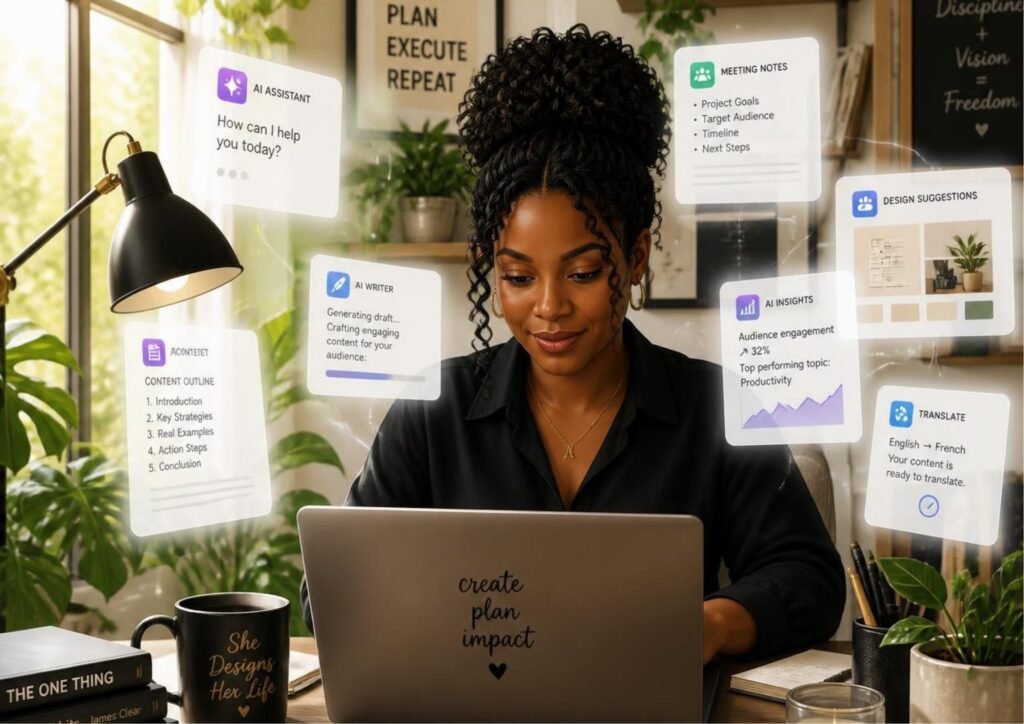
AI isn’t only changing jobs. It’s changing tasks.
One of the biggest misunderstandings about AI is that it will simply replace entire professions.
The reality is often more nuanced.
AI can change individual tasks within a role without eliminating the role itself.
A marketing professional might use AI to research an audience, generate campaign ideas or create a first draft of content.
An HR professional might use it to develop job descriptions, prepare interview questions or organise information.
Someone working in finance might use AI to support reporting, research or data analysis.
A business owner might use it to draft customer responses, organise administrative tasks or develop content.
A project manager might use it to structure meeting notes, identify actions or organise project information.
A professional in almost any sector can potentially find ways to use AI to reduce repetitive work, support decision-making or create a faster starting point.
UK Government research reflects this broader shift. Among businesses already using AI, marketing and administration were each reported as areas where AI was being used or planned for use by 72% of businesses, while IT followed at 64%.
This matters because it challenges the idea that AI is something you can simply leave to the technology team.
AI is increasingly becoming part of how work gets done.
But using AI occasionally isn’t the same as being AI literate
Perhaps you’ve already used ChatGPT.
Maybe you’ve asked it to rewrite an email, summarise an article or give you ideas for a presentation.
That’s a start.
But AI literacy goes further than knowing how to open an AI tool and type a question.
It means understanding what AI is capable of, where it can add value, where it can fail and how to use it responsibly.
It means knowing how to give AI useful context.
It means being able to assess whether an AI-generated response actually makes sense.
It means knowing when you should trust an output, when you should verify it and when you should ignore it altogether.
And increasingly, it means understanding how AI can connect with other tools and workflows to reduce repetitive work.
Skills England’s AI foundation skills benchmark makes this point clearly: AI is becoming part of everyday work, and people across jobs and sectors need the skills to use AI safely and effectively.
So the goal isn’t to turn every professional into an AI engineer.
The goal is to create AI-literate professionals who understand how to use these tools intelligently.
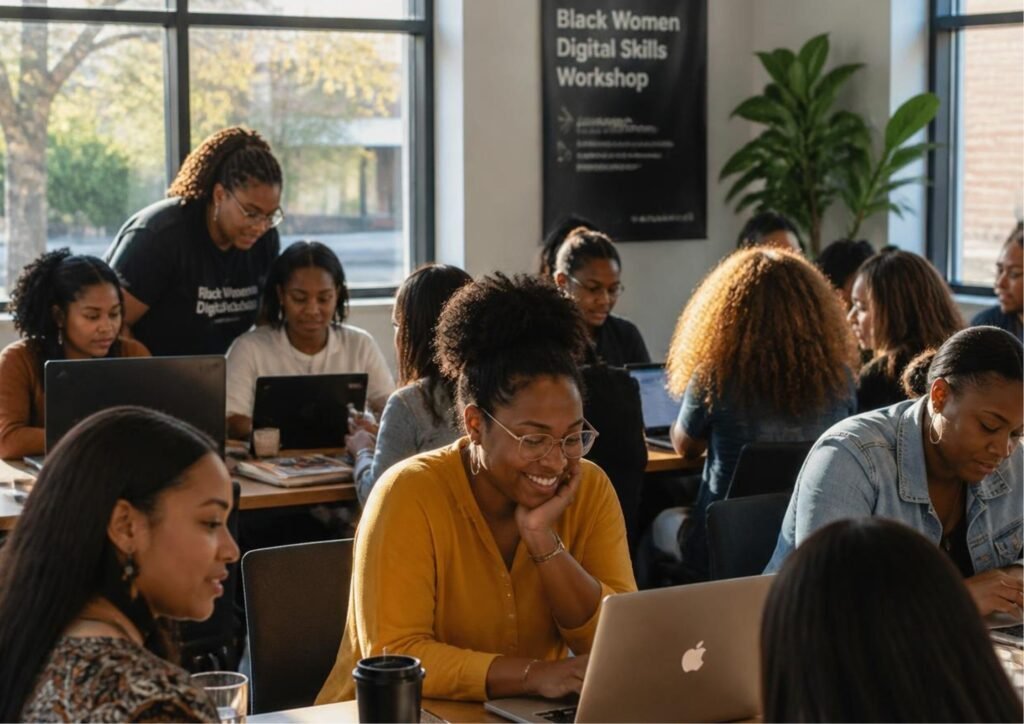
Why this matters particularly for women
There is a bigger question underneath the AI conversation: who gets access to the skills needed to participate in this shift?
The people who benefit most from new technologies are not necessarily the people who encounter them first.
Access to training, confidence, supportive workplaces, time to experiment and opportunities to practise all influence whether someone develops new skills.
That matters for women at different stages of their working lives.
For a woman early in her career, AI skills could become part of the toolkit she uses to stand out, learn faster and take on more responsibility.
For someone established in her career, understanding AI could help her adapt to changing expectations and identify opportunities to improve how she works.
For a business owner or freelancer, AI could help reduce administrative pressure and create more capacity for the work that actually generates income.
For someone considering a career change, AI literacy could become part of a broader professional development strategy.
And for women who have historically had less access to technology networks or technical training, practical, accessible opportunities to learn matter.
The UK’s AI labour market research also highlights an ongoing gender representation challenge: women accounted for 20% of AI roles in 2025, a four-percentage-point decline from 2020.
That figure refers specifically to AI roles, not women’s use of AI across the wider workforce, but it still points to an important issue: women need to be part of the conversation about who builds, uses and shapes AI.
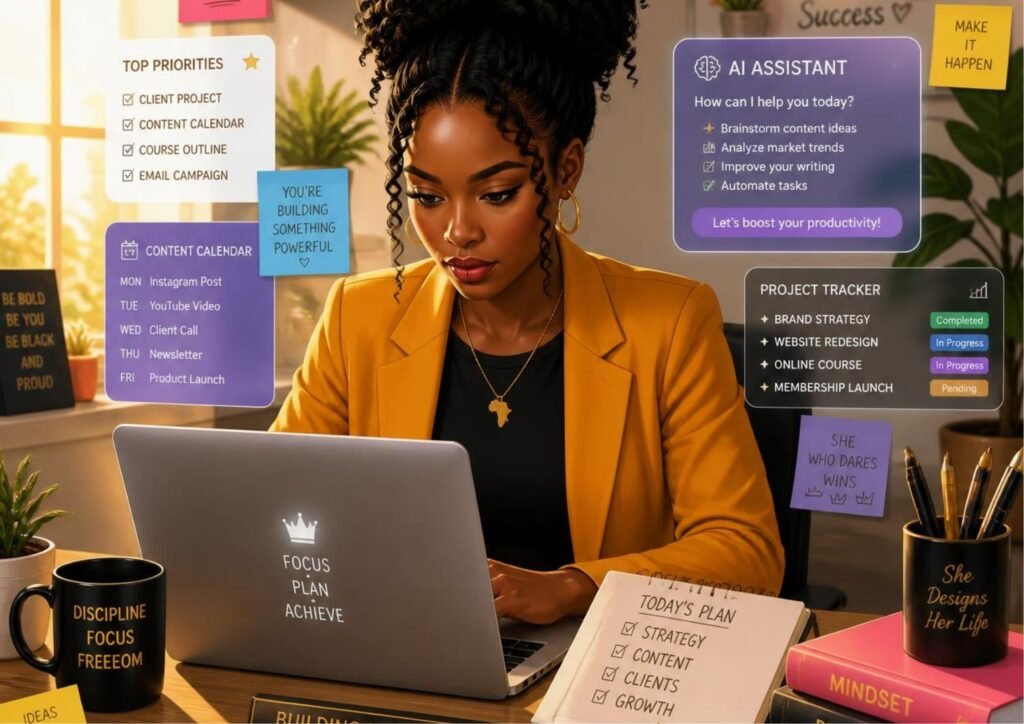
So, what AI skills should professionals start building?
You don’t need to learn everything at once.
Start with a few foundational skills.
1. AI literacy
Understand the basics.
What is generative AI? What can it do? What are its limitations? What are the risks around accuracy, bias, privacy and misinformation?
You don’t need to know how an AI model is technically built.
You need to understand enough to use it intelligently.
2. Prompting
Learning how to communicate effectively with AI is becoming a useful practical skill.
Good prompting isn’t about finding a magical sentence that makes AI perfect.
It’s about learning how to provide context, explain what you need, set useful constraints, ask the right questions and refine the result.
The better you communicate your objective, the more useful the starting point can become.
3. Automation and workflows
This is where AI can move beyond simply answering questions.
Start looking at your own work and asking:
What do I repeatedly do that could potentially be streamlined?
Perhaps it’s compiling information.
Perhaps it’s responding to similar enquiries.
Perhaps it’s organising notes.
Perhaps it’s creating a first draft.
Perhaps it’s moving information between different tools.
Understanding workflows and automation can help you identify opportunities to save time rather than simply adding another tool to your workload.
4. Critical thinking
This may be one of the most important skills of all.
AI can produce an answer very quickly.
That doesn’t mean the answer is correct.
Professionals still need to question information, check facts, understand context, recognise bias and make decisions.
As AI becomes more capable, human judgement doesn’t become less important.
It becomes more important.
5. Strategic application
Finally, learn to think beyond:
“What can this AI tool do?”
and start asking:
“What problem could AI help me solve?”
That shift matters.
Technology is useful when it solves a real problem, saves meaningful time, improves an outcome or creates an opportunity.
Being able to identify those opportunities is what moves someone from simply using AI to thinking strategically about it.
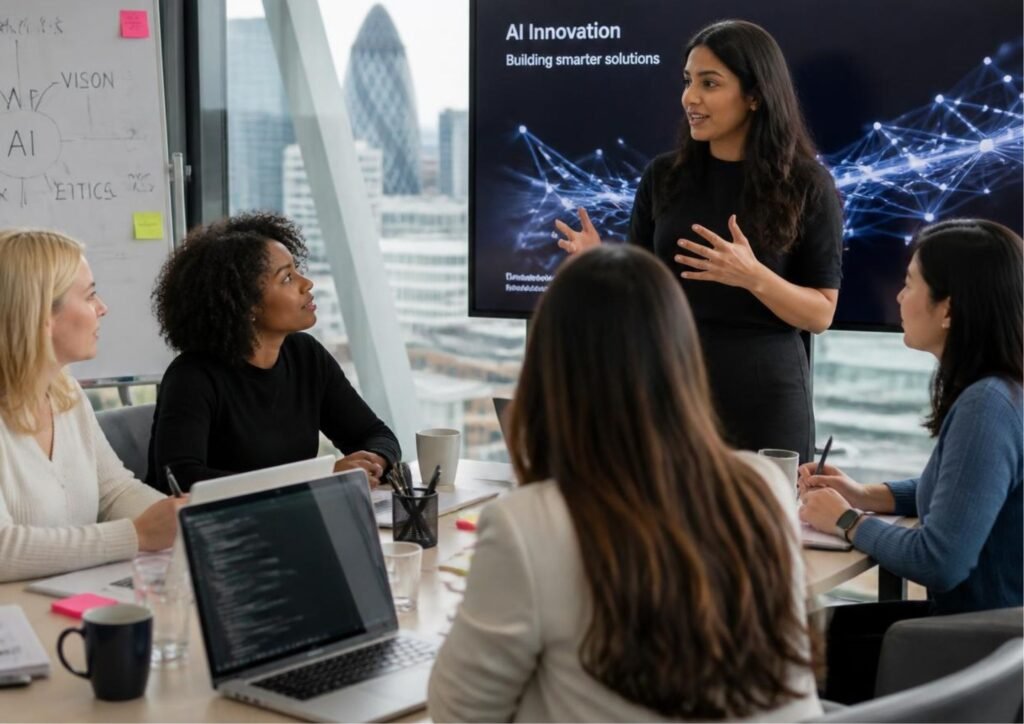
Learning to work with AI doesn’t mean giving up your human skills
There is understandable anxiety around AI.
People worry about job security. They worry about becoming replaceable. They worry that they are already behind.
Those concerns shouldn’t simply be dismissed.
AI will change some roles significantly, and some tasks will become automated.
But the answer isn’t to avoid AI.
It is to understand it.
Interestingly, UK businesses that are already adopting AI report benefits beyond automation. The latest Government research found that 75% of AI-using businesses reported improved workforce productivity, while 57% reported developing new or improved processes or operations.
At the same time, the research identifies limited AI skills and expertise as one of the barriers holding businesses back from adoption.
This creates an opportunity.
The professionals who learn how to combine AI with their existing expertise may be better positioned to contribute to that transformation.
Your industry knowledge still matters.
Your relationships still matter.
Your creativity still matters.
Your judgement still matters.
Your understanding of customers, colleagues and communities still matters.
AI can become another tool in that toolkit.
The goal isn’t to keep up with every new AI tool
There is a temptation to chase every new AI announcement.
A new model launches.
A new tool goes viral.
A new AI agent promises to change everything.
Then another one appears.
Trying to learn everything can quickly become overwhelming.
Instead, focus on building transferable AI skills.
Understand the fundamentals.
Learn how to communicate with AI.
Practise using it for real tasks.
Learn how to evaluate its outputs.
Explore automation.
And develop the judgement to decide when AI is useful — and when it isn’t.
Those skills are more durable than knowing how to use one particular platform.
Start where you are
You don’t need to completely transform your career overnight.
You could start with one task.
Take something you do every week and ask:
Could AI help me do this better, faster or differently?
Experiment.
Check the result.
Learn from it.
Then try another task.
Over time, those small experiments can become genuine capability.
And that capability matters because the future of work isn’t something that will suddenly arrive one day.
It is being built into workplaces now.
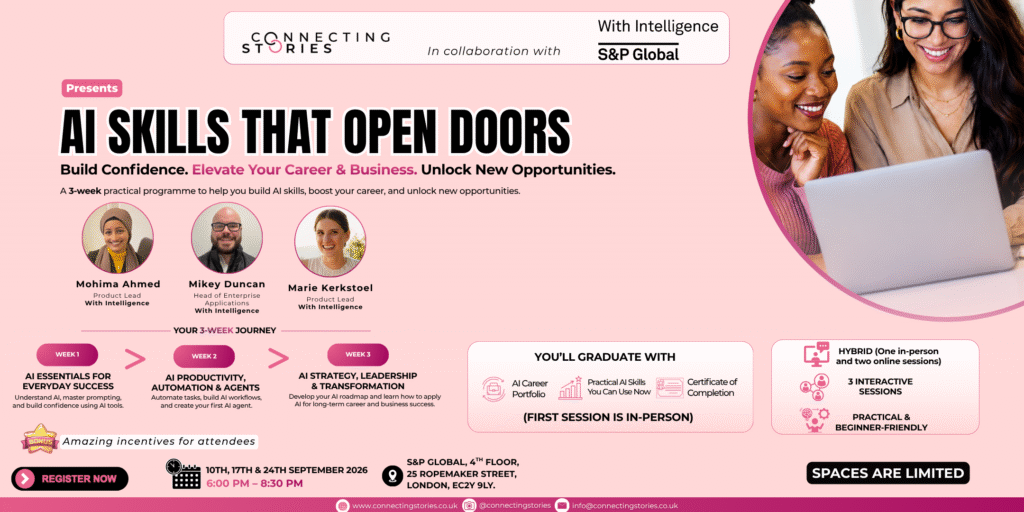
AI Skills That Open Doors
At Connecting Stories CIC, we believe financial empowerment and career empowerment go hand in hand.
Knowing how to manage your money matters.
But so does having the practical skills that can help you increase your earning power, progress in your career, build a business or adapt to a changing workplace.
That’s why we’re launching AI Skills That Open Doors, a three-week programme designed specifically to help women build practical AI skills.
Across three sessions, participants will move from understanding AI and effective prompting to exploring productivity, automation, AI workflows and strategic application.
The programme is designed to help women move from:
AI User → AI Builder → AI Decision-Maker
And thanks to the generous support of With Intelligence (S&P Global) and the Connecting Stories community, the inaugural cohort is free for registered participants.
Because the future of work shouldn’t be something women simply watch happen.
We should be equipped to participate in it, shape it and benefit from it.
You don’t need to become an AI expert.
But you do need to understand how AI is changing the way you work.
Are you ready?
Recommended Reads

How Much Should I Have in Savings in My 20s, 30s, 40s, 50s, and 60s?
Ify Bam
November 14, 2025