
Career success is only one part of a fulfilling life. Explore why women need to make space for their wellbeing, relationships, identity and future.
- Emmanuella
You’re Doing Well at Work. But Are You Doing Well in Life? | Connecting Stories

A promotion. A new role. A bigger salary. More responsibility. More recognition.
We know what career progress looks like.
There are job titles, salary increases, LinkedIn announcements, performance reviews and congratulatory messages.
But what does doing well in life look like?
That’s a much harder question.
And for women who are ambitious, career-focused and used to being the person who keeps everything moving, it is a question we don’t always stop to ask.

“How are you?”
It’s one of the most ordinary questions we ask each other.
“How are you?”
And how often does the answer become:
“Work has been crazy.”
“I’m so busy.”
“The project is going really well.”
“I’ve just been promoted.”
“I’m looking for a new role.”
Sometimes, without realising it, we answer a question about our lives with an update about our careers.
It’s understandable.
Work takes up a significant part of our lives. It gives us structure, income, relationships, responsibility and, for many of us, a sense of achievement and identity.
But it can also become the easiest thing to measure.
We can tell you whether our salary has increased.
We can tell you whether we’ve been promoted.
We can tell you what our next career goal is.
But can we tell you how we’re doing outside work?
The career success checklist
For many professional women, progress can look something like this:
✓ Promotion
✓ Salary increase
✓ New role
✓ More responsibility
✓ Leadership position
✓ Stronger professional profile
✓ New qualification
✓ Bigger network
And these things matter.
There’s nothing wrong with wanting to progress professionally. Career ambition isn’t something women need to apologise for.
But here’s the question:
What does your personal-life checklist look like?
How is your mental wellbeing?
How are your relationships?
How is your relationship with money?
How is your health?
Do you still make time for things that bring you joy?
Do you know who you are outside your job?
Are you building a future that looks good professionally and feels right personally?
These questions don’t usually come with an annual performance review.

The invisible areas we don’t measure
One reason it’s easy to become consumed by career progress is that professional achievement is highly visible.
Someone gets promoted, and everyone knows.
Someone launches a business, and everyone celebrates.
Someone changes jobs, and the LinkedIn post gets hundreds of reactions.
But some of the most important areas of our lives don’t have announcements attached to them.
There’s no LinkedIn notification for:
“I finally feel rested.”
Or:
“I’ve been making more time for my friendships.”
Or:
“I’m finally paying attention to my finances.”
Or:
“I’ve started enjoying my life again.”
Or:
“I know what matters to me outside my career.”
These things can be just as meaningful, but they are much harder to measure.
And when we’re constantly surrounded by messages about achievement, productivity and professional growth, it can become surprisingly easy to overlook them.
The UK reality: work doesn’t happen in isolation
For women in the UK, the question of work-life balance also exists within a wider reality of work, caring responsibilities, flexibility and wellbeing.
Women aren’t simply moving between “work mode” and “life mode”. For many, the two overlap.
There may be school runs, childcare, caring for relatives, household responsibilities, commuting, hybrid working, financial pressures and the mental load of keeping track of everything else.
Recent Office for National Statistics data highlights that women continue to spend more time on unpaid work than men. In March 2024, women spent an average of 57 minutes more per day on unpaid work than men.
And flexibility remains an important part of the conversation. CIPD research has found that flexible working can support employee wellbeing and work-life balance, while access to different forms of flexibility remains uneven.
So when we talk about “making more time for yourself”, it’s worth recognising that time is not always equally available to everyone.
This isn’t simply about telling women to wake up earlier, create a better morning routine or become more productive.
Sometimes the issue isn’t that we’re managing our time badly.
Sometimes there is simply too much competing for it.
And work can affect more than our calendars
The relationship between work and wellbeing is also worth taking seriously.
The CIPD’s 2025 Health and Wellbeing at Work research found that average employee absence had risen to 9.4 days per employee, the highest level reported in more than 15 years. Mental ill health was the leading cause of long-term absence, while stress was also a significant contributor to absence.
Its Good Work Index also found that 23% of employees reported feeling exhausted and 21% reported being under excessive pressure. A quarter said work had a negative impact on their mental and physical health.
These figures don’t mean that having a demanding career is inherently unhealthy.
They do, however, remind us that the way we work can affect the person doing the work.
And that person deserves attention too.
“I’ll deal with it when work settles down.”
This is where things can become interesting.
Because most of us know that certain parts of our lives need attention.
We just keep postponing them.
“I’ll focus on that when work settles down.”
“I’ll have more time next year.”
“Once I get this promotion…”
“Once this project is finished…”
“Once things calm down…”
The problem?
There is always another project.
Another deadline.
Another opportunity.
Another target.
Another busy season.
“Later” can quietly become a lifestyle.
And before you know it, you’ve become very good at building your career while continually postponing parts of your life.

What if success isn’t just about what’s happening at work?
Imagine looking at your life the way you look at your career.
Instead of asking only:
What position do I want next?
You ask:
What kind of relationships do I want to have?
Instead of:
How much more do I want to earn?
You ask:
What do I want my relationship with money to look like?
Instead of:
What’s my next professional milestone?
You ask:
What kind of life am I actually building?
Instead of:
How can I become more productive?
You ask:
What deserves more of my attention?
These aren’t questions designed to make you feel guilty about how you’re living.
They’re questions designed to help you notice.
Because you can’t make intentional decisions about parts of your life that you never stop to examine.
A simple life check-in
You don’t need to overhaul your life overnight.
Start with a few honest questions.
1. What part of my life am I proud of?
Not just professionally.
Think about your relationships, finances, health, family, friendships, personal growth or anything else that matters to you.
2. What part of my life have I been neglecting?
Be honest.
Is there something you’ve repeatedly pushed to the bottom of the list?
3. What have I been postponing?
The conversation.
The holiday.
The doctor’s appointment.
The hobby.
The financial decision.
The time with someone you love.
The thing you’ve been telling yourself you’ll get around to.
4. What have I started normalising?
Constant exhaustion?
Never switching off?
Missing important moments?
Having no time for yourself?
Feeling guilty whenever you rest?
5. What do I want more of?
More time?
More connection?
More financial security?
More creativity?
More rest?
More adventure?
More purpose?
There isn’t a correct answer.
The point is to start paying attention.
Your career is part of your life. It isn’t the whole of it.
Career ambition and personal wellbeing don’t have to be competing ideas.
You can want the promotion.
You can want the bigger salary.
You can want to lead.
You can want to build something of your own.
You can want to be recognised for what you do.
And you can also want a life outside of work that feels meaningful.
The goal isn’t to create a perfectly balanced life where every area receives exactly the same amount of attention every day.
That’s probably unrealistic.
Life changes.
Priorities change.
Some seasons will demand more from your career. Others will demand more from your family, health, relationships or personal life.
The important thing is being aware of which parts of your life are receiving your attention — and which parts are being left behind.
Because sometimes we don’t need another productivity strategy.
Sometimes we need to stop and ask:
“How is the woman behind the career doing?”
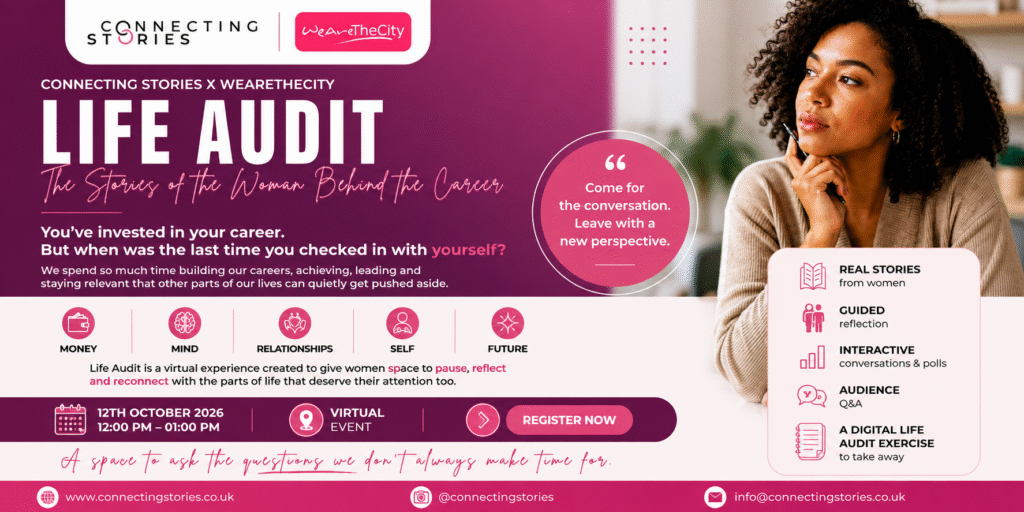
It’s time for a Life Audit
That’s the question behind Life Audit: The Woman Behind the Career, a virtual experience from Connecting Stories CIC in partnership with WeAreTechWomen.
The one-hour session creates space for women to pause, reflect and reconnect through five areas:
Money | Mind | Relationships | Self | Future
Through guided reflection, interactive conversations, audience questions and a digital Life Audit exercise, the experience is designed to move beyond another conversation about career progression and create space for the whole woman.
You don’t need to have everything figured out.
You don’t need a five-year life plan.
You simply need to be willing to pause and ask yourself some questions you may not have had time to ask lately.
Life Audit: The Woman Behind the Career
Date: 12 October 2026
Time: 12:00 PM – 1:00 PM
Venue: Virtual (Zoom)
One hour to pause. Reflect. Reconnect.
👉 Register for Life Audit on Eventbrite
Because your career matters. But so does the woman building the life around it.
Recommended Reads

How Much Should I Have in Savings in My 20s, 30s, 40s, 50s, and 60s?
Ify Bam
November 14, 2025