
Who are you beyond your job title? Explore professional identity, achievement and what it means to build a fulfilling life beyond your career.
- Emmanuella
Who Are You When You’re Not Working? | Connecting Stories

Imagine someone asks you to introduce yourself without mentioning your job, company, qualifications or achievements.
What would you say?
It sounds like a simple question.
Until you actually have to answer it.
For many ambitious women, our careers become such an important part of our lives that “what we do” can gradually become intertwined with “who we are”.
We introduce ourselves as the marketing manager, the lawyer, the founder, the director, the consultant, the entrepreneur.
We talk about the promotion we just received, the project we’re leading, the business we’re building or the qualification we’ve worked hard to earn.
And there is absolutely nothing wrong with being proud of those things.
But what happens when your professional identity becomes your primary identity?
Who are you when you’re not working?
When your job becomes your introduction
Professional identity is useful.
It gives people context. It tells them what we do, what we know and sometimes what we care about. In the UK, where work and professional networks can play such a significant role in our social lives, it’s easy for our careers to become a natural part of almost every introduction.
“I’m a lawyer.”
“I work in tech.”
“I’m a founder.”
“I’m a senior manager.”
“I work for…”
These descriptions aren’t necessarily a problem.
The question is what happens when they become the first — or only — answer we have when we’re asked who we are.
Because there is a difference between having a career and building your entire identity around your career.
One is a part of your life.
The other can quietly become the definition of it.

When achievement becomes identity
For ambitious women, this can happen gradually.
You work hard because you want to build something meaningful.
Then you get the promotion.
You take on more responsibility.
You earn more.
You become more senior.
You build a reputation.
You become the person people rely on.
And each achievement feels like confirmation that you’re moving in the right direction.
But somewhere along the way, achievement can become less about what you are doing and more about how you measure yourself.
You might notice it when:
- You feel guilty when you’re not being productive.
- Rest feels uncomfortable because there is always something else you could be doing.
- A quiet week makes you feel like you’re falling behind.
- You find yourself comparing your career progress with people around you.
- You struggle to describe your value when you’re between roles.
- You feel unsettled when work isn’t going well because it affects how you feel about yourself.
- Even time off becomes something you need to “make the most of”.
None of these things necessarily mean you’re unhappy with your career.
You can love your work and still need an identity beyond it.
That distinction matters.
The parts of you that don’t fit on LinkedIn
Think about your LinkedIn profile for a moment.
It might tell people where you work.
It might tell them what you’ve achieved.
It might list your skills, qualifications and experience.
But it probably doesn’t tell them what makes you laugh until your stomach hurts.
It doesn’t tell them about the people you love.
It doesn’t tell them what you do on a quiet Sunday afternoon.
It doesn’t tell them what gives you peace.
It doesn’t tell them what you are curious about outside your profession.
It doesn’t tell them the values you want your life to reflect.
And it certainly can’t capture every part of who you are.
There are parts of you that don’t need to be productive.
There are parts that don’t need to be monetised.
There are parts that don’t need to contribute to your career progression.
You might be a sister, daughter, partner, mother, friend, neighbour, volunteer, creative, reader, traveller, churchgoer, runner, cook, gardener or simply someone who loves sitting quietly with a cup of tea.
Some of those identities may feel significant.
Others may seem small.
But they are still part of your life.
And your life is bigger than your CV.

What happens when work stops?
One of the clearest ways to notice how much of our identity is tied to work is to imagine a period when work isn’t there.
Perhaps you’re taking annual leave.
Perhaps you’re on maternity leave.
Perhaps you’ve left a role and haven’t decided what comes next.
Perhaps you’re between jobs.
Perhaps you’ve retired.
Or perhaps you’re simply having a weekend where you don’t open your laptop.
What happens to your sense of self when your professional role temporarily disappears?
For some women, this can be surprisingly uncomfortable.
Without deadlines, meetings and targets to organise the day, there can suddenly be a lot more space.
And sometimes, that space brings questions we have been too busy to ask.
What do I actually enjoy?
What matters to me now?
Who do I want to spend more time with?
What have I been putting off?
What kind of life am I trying to build?
These aren’t necessarily career questions.
They’re life questions.
A successful career is only one part of a successful life
There is nothing wrong with ambition.
There is nothing wrong with wanting the promotion, pursuing a senior role, building a business, increasing your income or becoming excellent at what you do.
Women should not have to make themselves smaller in order to have a fulfilling life.
But ambition shouldn’t require you to abandon everything else.
A career can be successful while your relationships are struggling.
You can be progressing professionally while feeling disconnected from yourself.
You can be earning more while having less time for the things you enjoy.
You can have an impressive job title and still be asking yourself whether this is the life you actually want.
That’s why success needs to be defined more broadly.
Not just:
What have I achieved?
But also:
How am I living?
Who am I becoming?
Who am I connected to?
What am I making time for?
What brings me joy?
What kind of future am I building?

So, who are you when you’re not working?
You don’t need to have a perfect answer.
And you don’t need to suddenly reinvent your life.
Start smaller.
The next time someone asks, “What do you do?”, notice how quickly you reach for your job title.
Then ask yourself:
What else would I say if my career wasn’t available as an answer?
What do you care about?
What relationships matter most to you?
What makes you feel like yourself?
What do you want more time for?
What have you been postponing?
What parts of yourself have become quieter while your career has become louder?
These questions aren’t about rejecting your career.
They’re about making sure your career has a place in your life — rather than becoming your entire life.
There is a whole woman behind the career
Your job can tell people what you do.
It doesn’t tell them who you are.
And perhaps one of the most important career conversations isn’t always about the next role, promotion or achievement.
Perhaps it’s about making sure there’s still a whole woman behind all of it.
Someone with relationships to nurture.
A mind to care for.
A future to imagine.
A sense of self to protect.
A life to actually experience.
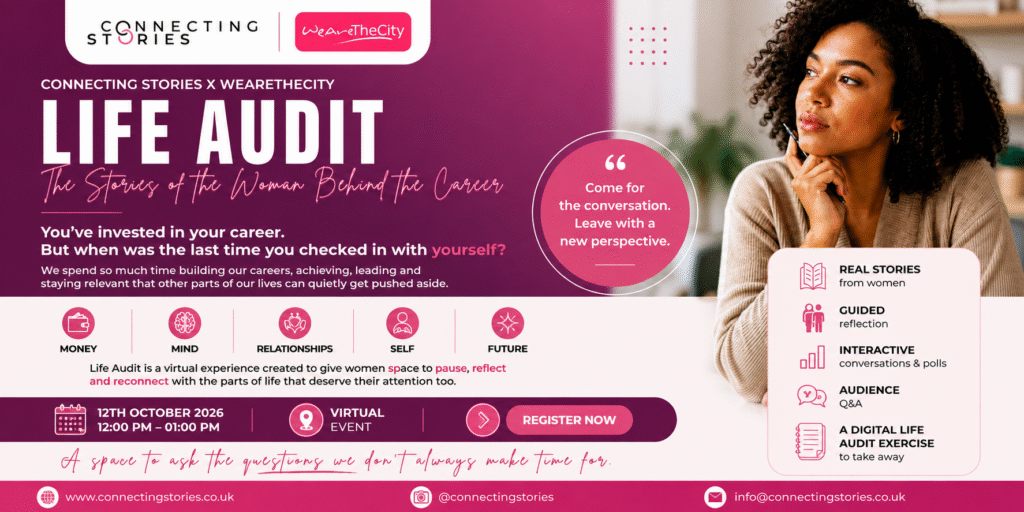
That is the thinking behind Life Audit: The Woman Behind the Career, a Connecting Stories CIC conversation designed to give women space to pause, reflect and reconnect with the parts of life that can easily get pushed aside when work takes centre stage.
We’ll explore five areas: Money, Mind, Relationships, Self and Future.
Because you have invested in your career.
When did you last invest in yourself?
Join the Life Audit conversation
Life Audit: The Woman Behind the Career
12 October 2026 | 12:00–1:00 PM UK time | Virtual
Take one hour to pause, reflect and reconnect with the woman behind the career.
Recommended Reads

Breaking Barriers: Career Growth Strategies for Women
Ify Bam
November 14, 2025

5 Branding Lessons Every Woman Entrepreneur Should Know
Emmanuella
June 3, 2026