
Using ChatGPT is only the beginning. Discover what it means to become AI-skilled, from prompting and productivity to automation, AI agents and strategic thinking.
- Emmanuella
From ChatGPT to AI Agents: What Does It Mean to Be AI-Skilled? | Connecting Stories

From ChatGPT to AI Agents: What Does It Actually Mean to Be AI-Skilled?
Being AI-skilled isn’t about knowing every AI tool. It’s knowing what to do with the tools you have.
If you’ve used ChatGPT to write an email, summarise a document or brainstorm ideas, congratulations.
You’ve already started.
But here’s the thing:
Using AI once in a while isn’t the same as being AI-skilled.
As artificial intelligence becomes more integrated into everyday work, there’s a growing difference between someone who occasionally asks an AI chatbot a question and someone who understands how to use AI to improve their work, automate processes, solve problems and make better decisions.
And you don’t need to be a software developer to get there.
In fact, the UK Government’s Skills England has identified AI foundation skills as something people across jobs and sectors need to use AI confidently, safely and effectively at work. Its framework includes skills such as writing clear instructions for AI, using AI for routine tasks, using simple automation, adjusting AI tools and evaluating AI-generated information.
So what does the journey actually look like?
Let’s break it down.

Level 1: The AI User
“I use ChatGPT.”
This is where many people begin.
You might use AI to:
- Draft an email
- Brainstorm ideas
- Summarise a long document
- Rewrite something
- Create a social media caption
- Research a topic
- Prepare for an interview
- Generate ideas for your business
There’s nothing wrong with this.
These are useful applications.
But at this stage, AI is often something you visit when you need it.
You have a task.
You open ChatGPT.
You ask a question.
You get an answer.
Then you move on.
The next step is understanding how to make AI a more consistent part of how you work.
Level 2: The AI-Powered Professional
“How can AI help me do my work better?”
This is where things start getting more interesting.
Instead of thinking about AI as a chatbot, you begin thinking about it as a workplace tool.
You start identifying the tasks that take up your time and asking:
Could AI help me do this faster, better or differently?
For example, a marketing professional might use AI to:
- Research an audience
- Analyse campaign information
- Develop content ideas
- Draft a first version of a campaign
- Repurpose existing content
An HR professional might use it to:
- Structure job descriptions
- Develop interview questions
- Organise information
- Summarise employee feedback
A business owner might use it to:
- Draft customer communications
- Develop ideas
- Research competitors
- Create first drafts of documents
- Organise business information
A finance professional might use AI to:
- Summarise reports
- Identify patterns in information
- Support analysis
- Prepare questions for further investigation
The important shift is this:
You’re no longer asking, “What can ChatGPT do?”
You’re asking:
“What could AI help me do in my work?”
That is a much more powerful question.
Why Prompting Is a Real Skill
One of the simplest ways to improve your AI capability is to learn how to give AI better instructions.
A prompt is essentially the instruction you give an AI tool.
Compare:
“Write a LinkedIn post about AI.”
with:
“I’m a marketing professional writing for UK-based women working in non-technical roles. Create a 150-word LinkedIn post explaining three practical ways AI can improve workplace productivity. Keep the tone conversational and avoid technical jargon.”
The second instruction gives the AI considerably more information to work with.
You’re providing:
Context + objective + audience + format + constraints.
That’s why prompting isn’t simply about knowing what words to type into ChatGPT.
It’s about learning how to communicate your intended outcome clearly.
Skills England’s AI foundation benchmark specifically includes writing clear instructions for AI tools because better instructions can improve the quality and accuracy of AI-generated information.
Level 3: The AI Builder
“How can I build AI into the way I work?”
This is where you move beyond individual prompts and start thinking about workflows.
Imagine you have a task that involves five steps.
You might currently:
- Collect information
- Organise it
- Summarise it
- Draft something
- Send the final output
Instead of doing everything manually, you start asking:
Which parts could AI or automation support?
This could mean creating a workflow where different tools handle different stages.
For example:
Information comes in → AI summarises it → key information is organised → you review it → final output is created.
The exact workflow will depend on the job and the tools available.
But the principle is simple:
Don’t just use AI for individual tasks. Learn to design better ways of working with it.
And importantly, automation doesn’t necessarily require coding.
Skills England’s foundation benchmark specifically includes using simple software to automate work tasks, such as sending reminders, without needing coding skills.

So, What Are AI Agents?
This is where the conversation is moving next.
You’ve probably heard the phrase “AI agent” increasingly often.
An AI chatbot typically responds to the instruction you give it.
An AI agent can be designed to go further.
In simple terms, an AI agent can work towards a goal by carrying out a sequence of actions, potentially using tools or information sources along the way.
Think of the difference like this:
Chatbot:
You:
“Summarise this report.”
AI:
“Here is the summary.”
Agentic workflow:
You:
“Review these incoming reports each week, identify the key changes, organise them according to these categories and prepare a draft summary for me to review.”
The second example involves a multi-step process rather than one isolated response.
This doesn’t mean you should hand over important decisions to an AI agent.
Quite the opposite.
The more capable AI systems become, the more important it is to understand what they are doing, what information they have access to and where human oversight is needed.
Recent UK Government research shows that agentic AI is still relatively new in business adoption: among UK businesses already using AI, only 7% reported using agentic AI in the research conducted in 2025.
So you don’t need to panic because you haven’t built an AI agent yet.
But understanding the direction of travel is useful.
Level 4: The AI Decision-Maker
This is perhaps the most important level.
Because being AI-skilled isn’t ultimately about tools.
It’s about judgement.
An AI-skilled professional can ask:
Should I use AI for this?
Which tool is appropriate?
What information can I safely provide?
How much human oversight is needed?
Can I trust this output?
What needs to be verified?
What should remain a human decision?
This is where AI literacy becomes much more than technical knowledge.
The UK Government’s AI foundation skills benchmark places responsible and ethical use alongside technical and non-technical skills. It specifically highlights understanding AI risks and consequences, checking outputs for accuracy, spotting errors and recognising patterns and trends.
That matters because AI can be confidently wrong.
It can misunderstand context.
It can reproduce bias.
It can generate inaccurate information.
It can handle sensitive information in ways you may not have intended.
So an AI-skilled professional isn’t someone who blindly trusts AI.
They’re someone who knows when to use it, how to use it and when to question it.

What Does This Mean for Women in the UK?
This conversation matters because access to AI skills isn’t evenly distributed.
Recent UK research found that only 21% of UK workers feel confident using AI at work, while women reported lower confidence than men in using AI at work — 16% compared with 26%. The same research found that women were also less likely to have undertaken AI training.
That gap matters.
Because if AI becomes increasingly embedded in how organisations work, confidence and practical skills could influence who feels able to take advantage of new opportunities.
For women, this could mean different things depending on where you are in your career.
If you’re early in your career
AI skills could help you become more productive, experiment with new ways of working and develop a broader professional toolkit.
If you’re established in your career
AI literacy could help you adapt as your role changes and identify opportunities to improve your existing workflows.
If you’re returning to work
Building confidence with current workplace technologies can be part of preparing for your next opportunity.
If you’re a freelancer or business owner
AI could help you manage some of the research, content, administration and repetitive tasks that compete for your time.
If you’re considering a career change
AI skills can complement your existing professional experience rather than requiring you to start your career again from scratch.
And this is an important distinction:
You don’t have to become an AI specialist to become AI-skilled.

Your Existing Expertise Still Matters
There’s sometimes a dangerous assumption in conversations about AI:
“If AI can do this task, then my expertise doesn’t matter anymore.”
That’s not necessarily true.
Imagine an AI tool generates a marketing strategy.
Who knows whether it actually makes sense for your audience?
The marketer.
AI produces an analysis of a business problem.
Who understands the context behind the numbers?
The professional who knows the business.
AI generates a proposal.
Who understands the relationship with the client?
The person managing that relationship.
AI can help produce an output.
But human experience provides context.
Your judgement, creativity, communication, relationships and understanding of your industry remain valuable.
The opportunity is to combine those strengths with AI.

The Four-Stage AI Skills Journey
Think about your progression like this:
1. AI USER
“I know how to use AI tools.”
↓
2. AI-POWERED PROFESSIONAL
“I know how AI can improve my work.”
↓
3. AI BUILDER
“I know how to create AI-powered workflows.”
↓
4. AI DECISION-MAKER
“I know when, where and how AI should be used.”
You don’t necessarily have to move through these stages in a perfectly linear way.
But the framework gives you somewhere to go beyond simply “I have tried ChatGPT.”
You Don’t Need to Learn Every AI Tool
This might be one of the most important things to remember.
There are new AI tools appearing constantly.
Trying to keep up with all of them is exhausting.
And it isn’t necessary.
The tools will change.
The underlying skills are more durable.
Focus on learning how to:
Understand AI.
Give it clear instructions.
Use it for meaningful tasks.
Build simple workflows.
Evaluate its outputs.
Protect sensitive information.
Make informed decisions about when to use it.
Those skills can travel with you even when the tools themselves change.
From Understanding to Action
This is also why AI training shouldn’t stop at explaining what AI is.
Information is useful.
But application is where capability develops.
You can watch 20 videos about prompting.
But until you actually write prompts, test them, refine them and compare the results, you haven’t really built the skill.
You can read about automation.
But until you identify a repetitive task in your own work and explore how it could be streamlined, the idea remains theoretical.
You can hear about AI agents.
But understanding what they can and cannot do becomes much more useful when you start thinking about where agentic workflows could fit into real work.
Learn → Practise → Apply → Review → Improve.
That’s the cycle that builds confidence.

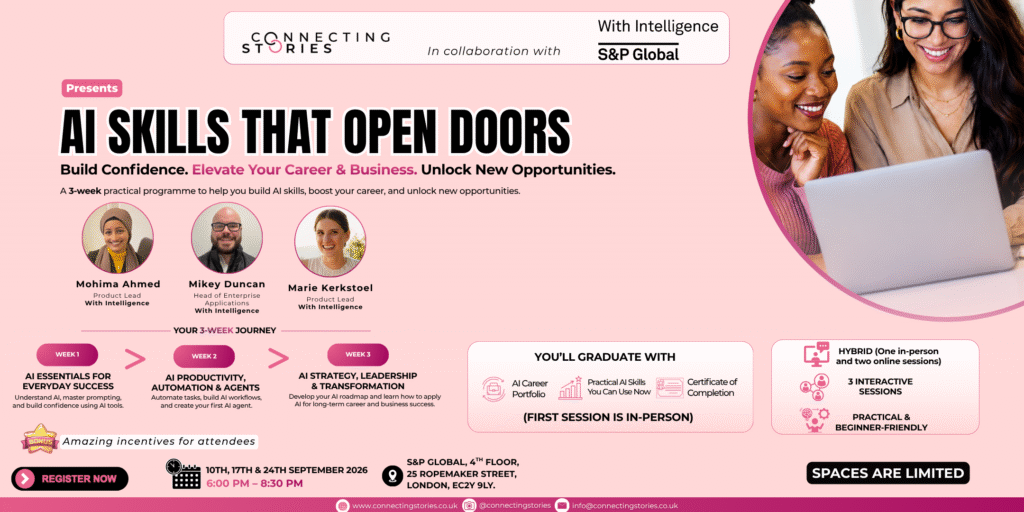
AI Skills That Open Doors
This is exactly the thinking behind AI Skills That Open Doors, our three-week programme for women at Connecting Stories CIC.
Rather than treating AI as something abstract or purely technical, the programme is designed around a practical progression.
Week 1: Understand & Use AI
AI Essentials for Everyday Success
Build your understanding of AI, develop your prompting skills and gain confidence using AI tools.
Week 2: Automate & Build
AI Productivity, Automation & Agents
Explore how AI can streamline tasks, build workflows and support the creation of your first AI agent.
Week 3: Strategise & Transform
AI Strategy, Leadership & Transformation
Move beyond individual tools and develop an AI roadmap for longer-term career and business success.
The aim isn’t to turn every participant into an AI engineer.
It’s to help women move from using AI occasionally to thinking more confidently and strategically about what AI can do for them.
The Future Doesn’t Belong Only to AI Experts
You don’t need a computer science degree.
You don’t need to know how to build a large language model.
You don’t need to understand every new AI tool.
And you certainly don’t need to become an expert overnight.
But you do need to start developing the ability to work with AI intelligently.
Because the future of work isn’t simply about people versus AI.
It’s increasingly about people who know how to work effectively with AI.
And the earlier you start building that capability, the more confident you can become in deciding where AI fits into your career, your business and your working life.
Being AI-skilled isn’t about knowing every AI tool.
It’s knowing what to do with the tools you have.
About AI Skills That Open Doors
AI Skills That Open Doors is a three-week practical programme for women, delivered by Connecting Stories CIC in collaboration with With Intelligence (S&P Global).
The inaugural cohort takes participants through three stages:
Understand & Use → Automate & Build → Strategise & Transform
The programme combines practical learning with real-world application, helping women build AI skills they can use in their careers, businesses and everyday work.
The inaugural cohort is free for registered participants, thanks to the support of S&P Global and the Connecting Stories community.
Ready to move beyond simply using ChatGPT?
Learn. Apply. Advance.
Recommended Reads

How Much Should I Have in My Emergency Fund?
Ify Bam
November 14, 2025

How Much Should I Have in Savings in My 20s, 30s, 40s, 50s, and 60s?
Ify Bam
November 14, 2025